Add to quote
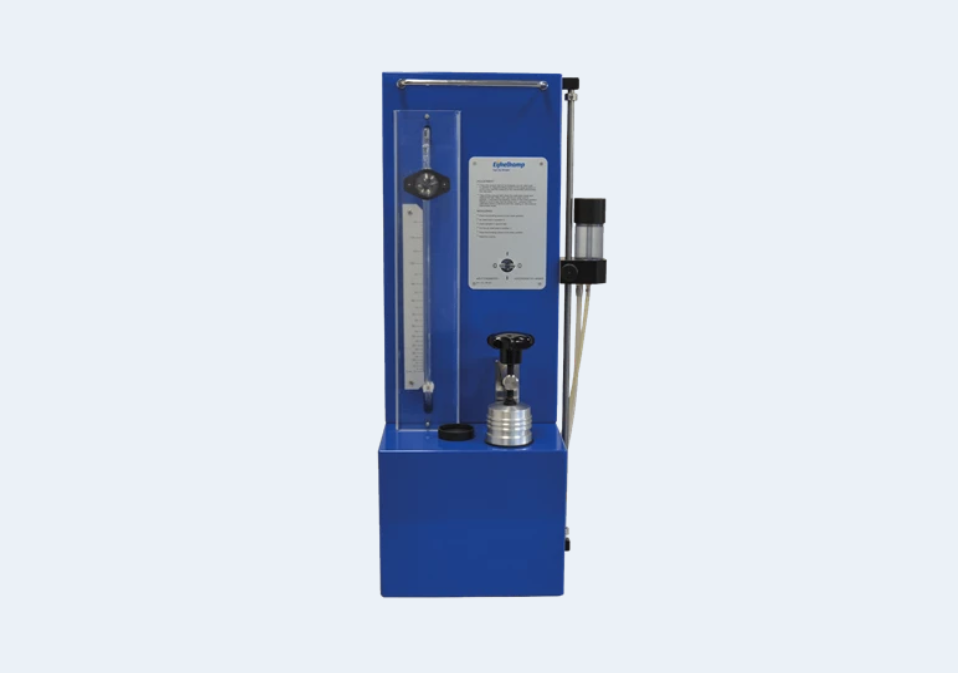
The vacuum air pycnometer has been designed to determine the volume and density of solid material, such as soil samples. It can be applied in every field where it's important to calculate a specific weight, such as soil research, powder- and granulate investigations for the pharmaceutic industry, road building, brick factories, and the food industry (coffee, leguminous plants, etc.). The apparatus is especially useful to measure the volumes of irregularly shaped objects.
The principle
An under pressure is created in the vacuum bell that the object to be measured is placed in. Depending on the gas volume present in the bell, more or less air will be extracted. The quantity of the air present is independent of the volume taken by the object to be measured. After the under pressure has stabilised, the volume of the object can be read from the calibrated scale.
Remarks
Applications
The pycnometer can be applied wherever knowing a specific weight is desired:
Limitation: Temperature variations influence the measurements (can be prevented by climate control in the laboratory).
Specifications
Air pycnometer
Maximum number of samples 1
Measuring range 0 - 115 cm3
Sample specification Undisturbed
Measured parameters Porosity and density
Reading accuracy 1 cm3
Sample stored in Ring
Package size 101 x 53 x 50 cm
Weight 13.6 kg